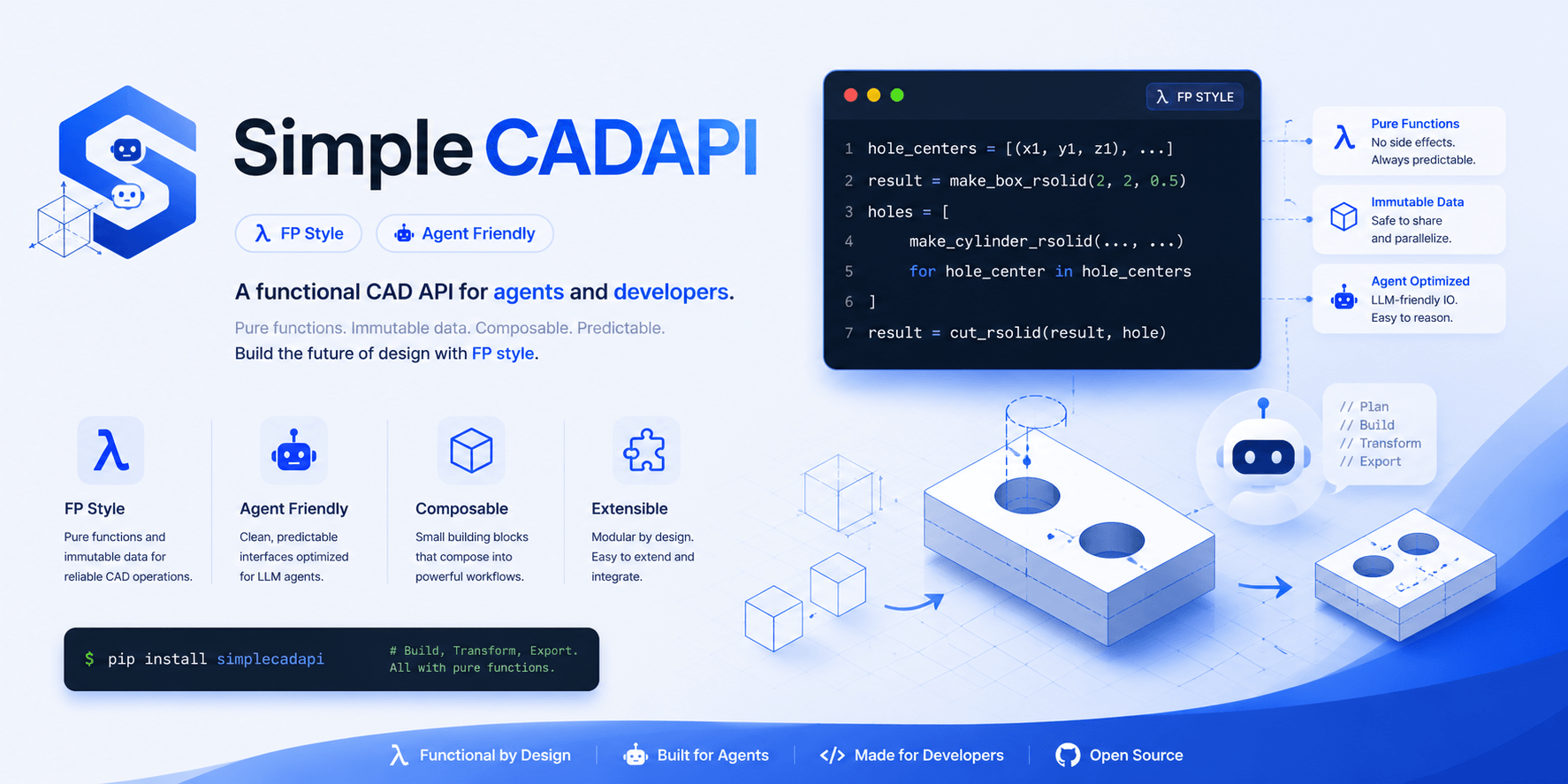
# SimpleCADAPI
[中文说明](README.zh-CN.md)
---
---
SimpleCADAPI is an OCP-native Python SDK for building CAD models with clear,
functional operations and replayable model graphs. It wraps OpenCascade geometry
in a compact public API for creating solids, applying features, tagging semantic
intent, querying topology, exporting manufacturing files, and translating recorded
models into FreeCAD workflows.
Current release: `simplecadapi==2.0.2`.
## What It Provides
- OCP-native shape types: `Vertex`, `Edge`, `Wire`, `Face`, and `Solid`.
- Functional modeling operations for primitives, profiles, extrude, revolve,
loft, sweep, booleans, transforms, patterns, fillets, chamfers, and shells.
- Replayable modeling with `@model`, `ModelResult`, `capture_result(...)`,
`import_model_json(...)`, and `replay_model_json(...)`.
- Expression parameters with `var(...)`, arithmetic expressions, and serialized
expression graphs.
- Physical units with automatic dimension inference, canonical CAD conversion,
and manufacturing tolerance-chain validation.
- QL selectors for geometry grounding, topology queries, and stable feature
selections.
- Semantic tags through `apply_tag(shape=..., tag=...)` and `list_tags(shape=...)`.
- STEP/STL export and FreeCAD translation helpers for script or `.FCStd` output.
## Install
```bash
pip install simplecadapi
```
With `uv`:
```bash
uv add simplecadapi
```
For local development from this repository:
```bash
uv sync --group dev
```
## Quick Start
```python
from pathlib import Path
import simplecadapi as scad
out = Path("out")
out.mkdir(exist_ok=True)
base = scad.make_box_rsolid(
width=60.0, height=36.0, depth=8.0, bottom_face_center=(0.0, 0.0, 0.0)
)
hole = scad.make_cylinder_rsolid(
radius=5.0, height=14.0, bottom_face_center=(0.0, 0.0, -3.0)
)
slot = scad.make_box_rsolid(
width=18.0, height=8.0, depth=14.0, bottom_face_center=(14.0, 0.0, -3.0)
)
part = scad.cut_rsolid(base, hole, slot)
boss = scad.make_cylinder_rsolid(
radius=8.0, height=7.0, bottom_face_center=(-18.0, 0.0, 8.0)
)
part = scad.union_rsolid(part, boss)
part = scad.apply_tag(shape=part, tag="role.demo.bracket")
print("volume", round(part.get_volume(), 3))
print("faces", len(part.get_faces()))
print("tags", scad.list_tags(shape=part))
scad.export_step(shapes=part, filename=str(out / "bracket.step"))
scad.export_stl(shapes=part, filename=str(out / "bracket.stl"))
```
## Replayable Modeling
Use one `@scad.model` entry point when a model should be inspectable,
serializable, replayable, or translated into another CAD environment. The
decorated function owns its `GraphSession` and returns a `ModelResult`.
```python
import simplecadapi as scad
from simplecadapi import ql as Q
@scad.model(graph_id="chamfered_block")
def build_model():
body = scad.make_box_rsolid(
width=40.0, height=24.0, depth=10.0,
bottom_face_center=(0.0, 0.0, 0.0),
)
cutter = scad.make_cylinder_rsolid(
radius=4.0, height=16.0, bottom_face_center=(0.0, 0.0, -3.0)
)
drilled = scad.cut_rsolid(body, cutter)
bottom_circle = (
Q.edges()
.where(Q.curve_type(kind="circle"))
.order_by(Q.center_axis(axis="z"))
.take(1)
.exactly(1)
)
final = scad.chamfer_rsolid(solid=drilled, edges=bottom_circle, distance=0.6)
scad.capture_result(value=final)
return final
result = build_model()
model_json = result.model_json
rebuilt = result.replay()
print("recorded_nodes", result.session.graph.node_count)
print("replayed_outputs", len(rebuilt))
```
Pass `export_dir=...` to `@scad.model` when the invocation should also write
one self-contained `.scene.zip`. The package contains `scene.json`,
`model/model.json`, the complete project-relative Python files referenced by
operation source mappings under `sources/`, and the GLB/entity assets required
by the Viewer. Automatic export does not write adjacent model/session JSON,
STEP, STL, or FCStd files; those explicit export APIs remain available. The
package path is `result.artifact_paths["scene"]`. Without `export_dir`, model
execution remains in memory.
## Physical Units And Tolerances
Declare nominal and manufacturing-tolerance units at the variable boundary.
SimpleCAD evaluates lengths in millimeters and angles in degrees while preserving
the declaration units in model JSON:
```python
import simplecadapi as scad
width = scad.var(
"width",
1.0,
unit="in",
tolerance=0.1,
tolerance_unit="mm",
)
height = scad.var("height", 40.0, unit="mm", tolerance=0.2)
diagonal = scad.sqrt(width**2 + height**2)
analysis = scad.analyze_tolerance(diagonal)
check = scad.check_tolerance(diagonal, 0.3, tolerance_unit="mm")
print(analysis.dimension.name, analysis.unit.symbol)
print(analysis.nominal, analysis.lower_bound, analysis.upper_bound)
print("passes", check.passed)
```
Addition and subtraction require matching dimensions. Multiplication, division,
integer powers, and square root derive dimensions. Trigonometric functions require
angle or dimensionless inputs as appropriate. Legacy variables without `unit`
remain supported, but cannot be mixed with unit-declared variables in one
expression.
## Modeling Mental Model
- Start from design intent: reference axes, critical profiles, and the features
that produce the final solid.
- Build from lower-dimensional geometry to higher-dimensional geometry: profile
wires/faces first, then solid features such as extrude, revolve, loft, and
sweep.
- Keep operations functional. Create new values with public functions such as
`make_rectangle_rface(...)`, `extrude_rsolid(...)`, `cut_rsolid(...)`, and
`fillet_rsolid(...)`.
- Use tags for semantic intent and selection anchors, for example
`role.mounting.surface`, `anchor.datum.primary`, or `group.fasteners`.
- Store numeric and geometric facts in metadata or graph payloads, not in tags.
- Use QL to ground selections by geometry facts rather than relying on topology
iteration order.
- When an indexed topology pick is intentional, pass the index to the plural
child-geometry getter, such as `get_edges(index)`, `get_faces(index)`,
`get_wires(index)`, or `get_vertices(index)`, so replayable graph workflows
preserve the pick as a geo select node.
- Use model JSON as the interchange boundary for replay, tests, and FreeCAD
translation.
## FreeCAD Translation
Recorded model JSON can be translated into a FreeCAD Python script:
```python
script = scad.translator.freecad_translator.translate_model_json_to_freecad_script(model_json)
```
If FreeCAD or FreeCADCmd is available, the same model JSON can be written as an
`.FCStd` file:
```python
scad.translator.freecad_translator.translate_model_json_to_fcstd(model_json, "bracket.FCStd")
```
Part/Assembly models are written as editable FreeCAD assembly structure: parts are
`App::Part`, assemblies are `Assembly::AssemblyObject`, and components are links.
Explicit compound projections remain available for geometry-only STEP export.
## Examples
Run examples from the source checkout:
```bash
uv run python examples/04_dimension_tolerance_chain.py
uv run python examples/08_constrained_sketch.py
uv run python examples/09_naca0016_blade_freecad.py
uv run python examples/10_part_assembly.py
uv run python examples/16_compact_two_stage_planetary_reducer/main.py
uv run python examples/20_integrated_bldc_joint_actuator/main.py
```
## Documentation
- Public API reference: [`docs/api/`](docs/api/)
- Core type and modeling notes: [`docs/core/`](docs/core/)
- Serialization and replay details:
[`docs/core/serialization/README.md`](docs/core/serialization/README.md)
- Dimension tolerance chains:
[`docs/core/dimension-tolerance-chains.md`](docs/core/dimension-tolerance-chains.md)
- Physical units and dimension inference:
[`docs/core/physical-units.md`](docs/core/physical-units.md)
- Operation graph JSON spec:
[`docs/core/operation_graph_json_spec.md`](docs/core/operation_graph_json_spec.md)
## Releasing the Agent Skill
The repository includes a thin Agent Skill under `skills/simplecadapi/`. It
contains generated API and modeling references, but does not bundle the SDK
source code.
From a clean checkout, update the project version and documentation, then build
and validate the release artifacts:
```bash
uv sync --group dev
uv run skill-pack --refresh-docs --archive
uv run python -m pytest test/test_skill_pack.py
```
The command refreshes the generated docs, rewrites `skills/simplecadapi/`, and
creates `skills/simplecadapi.tar.gz`. Review the generated `SKILL.md` and
references before release:
```bash
git diff -- skills/simplecadapi docs
tar -tzf skills/simplecadapi.tar.gz
```
Commit the generated `skills/simplecadapi/` directory and refreshed `docs/`
with the release. The archive is intentionally ignored by Git; attach
`skills/simplecadapi.tar.gz` to the corresponding GitHub release or distribute
it through the target Agent Skills registry.
## Development
```bash
uv sync --group dev
uv run python -m pytest test tests
python3 -m compileall src/simplecadapi
```
## License
AGPL-3.0, see [`LICENSE`](LICENSE).
## Community
The group chat currently has too many members for direct QR-code joining. Scan the QR code below to add Teacher Du Peng on WeChat, then ask him for an invitation to the CADDesigner technical community: